Translate

Thursday, October 8, 2015

Blog 8 - Independent Component 1 Proposal


1.  Describe in detail what you plan to do for your 30 hours.


  • I didn't know what I was going to do but I've decided to do 30 extra hours of mentorship. 

2.  Discuss how or what you will do to meet the expectation of showing 30 hours of evidence.


    • I will be taking notes and typing out those notes into my log. I will also take pictures and videos. 
    3.  Explain how what you will be doing will help you explore your topic in more depth.

    • This will help me watch speech therapist in action and experience real sessions with clients of all ages. 
    4.  Update your Senior Project Hours log.

    Thursday, October 1, 2015

    Blog 7 - Second Interview Preparation


    1.  Who is your mentor and where do they work?  If their workplace does not reflect their expertise, what makes them an expert?
    • My mentor is Sara Romo Miranda. She is a speech therapist with her own private practice. She is a SLPA, a speech-language pathologist, not an SLPA , speech-language pathologist assistant. Since she's a SLP, it means thats she has her Masters degree in her field. In my grandma's case, its her Masters degree in Sciences and Communicative disorders. 
    1. What college did you go to , and for how many years?
    1. Do you have your undergraduate degree in anything? 
    1. How long was he process to open you own speech clonic?
    1. Did you need another degree to open the clinic?
    1. How long has your clinic been open and what kind of struggles have you encountered that you weren't expecting? 


    2. What five questions will you ask them about their background?


    Thursday, September 24, 2015

    Blog 6 - Advisory Prep


    1. What has worked well for you concerning senior project this year? What has made it a positive experience for you?
    • When I started my senior project with my grandmother as my mentor, I was worried I was going to grow quite weary of her. It has actually turned out to be quite the opposite, I look forward to watching my grandmother work, and by extension, I look forward to watching her other SLPA's do their jobs as well. Working with someone so near and dear to my heart has been more of a positive experience than I was expecting going into this project.
    2.What are you finding difficult concerning senior project? How can you adapt to make that portion work better for you? How might the senior team help?
    • What I'm finding difficult concerning my senior project is finding an essential question. Im not sure how I can adapt to make that portion work better for me? I suppose just doing more and more research would do. I'm also not sure what the senior team might do to help. I'm not even sure what direction I want to take my essential question nor am I aware of what are of Speech-Language Pathology I should focus in on. 


    Thursday, September 17, 2015

    Blog 5 - Interview 1 Reflection


    1. I learned that every speech therapist, whether they work in a clinical setting, a school setting, or  a home setting, has a specific standard of work and even in that, no speech therapist performs them the same. There is no correct way to help a child learn especially because every lesson plan is crafted specifically for that child. In reality, everything depends on the client.
    2. I don't regret interviewing David or the way that the interview went. If I were to change anything, it would jus the of course to interview someone different. As in, instead of interviewing a SLPA in a clinical setting, like David, I'd interview a SLPA in a hospital setting because they're two completely different work environments and they work with completely different clients. 
    3. During this interview, David didn't specifically give me specific contacts but he did recall an introductory book on Speech Pathology that he would get me the name of sometimes after the interview.
    4. Since I haven't received the book yet, I can't give an accurate description but I feel that since David used it at the beginning of his journey into Speech Pathology, that it could be very beneficial to me. I'll make sure to get back to you on that.
    5. What makes my interviewee qualified to help me is the fact that he as an SLPA works under my mentor, Sara Miranda, who's an SLP. Sara Miranda has a Master's Degree in Sciences and Communicative Disorders which makes her an expert in her field and for David to be under her wing makes him also on his way to becoming an expert in his field. David has been working 2 years at My World Speech Therapy and plans to go back to school for his Masters degree in one year.

    Wednesday, September 9, 2015

    Blog 4 - House Advisory Prep 1


    What I hope to accomplish through my senior project topic is to discover whether Speech-Language Pathology should be a career path that I seriously consider to pursue. My mother and grandmother are both speech therapist and my grandma is the owner of a Speech-Language Pathology business. This being said,  if I were to go into speech therapy, it would be very easy for me to get a job and make a living. At this point in my life though, I can't see myself every being in the communicative disorder field, and definitely not Speech-Language Pathology. So, like I stated above, I would like to see if, by me dedicating a year of my life to Speech-Language Pathology, it could be a serious career choice in the future.

    Wednesday, September 2, 2015

    Blog 3 - First Interview Preparation


    1. Who do you plan to interview? Why? 


    • I plan to interview Speech-Language Pathologist Veronica Guitron. I plan to interview Veronica because she is a licensed Speech Therapist which means she has to be an expert in her field . I deem her an expert in her field  because in order to get your Speech-Language Pathology license you much have a master's degree from one of 300+ accredited programs. 
    2. Five additional questions.
    1. What made you interested in becoming a Speech-Language Pathologist? 
    1. Did you know from a young age that this was the career you were going to end up with?
    1. Had you not gone to school for Speech-Language Pathology, what would you have gone to school for? 
    1. Could you see yourself going to school longer to get a higher degree in your field? 
    1. Do you eventually want to be an owner of your own private practice ?


    Sunday, August 23, 2015

    Blog 2 - Summer Mentorship

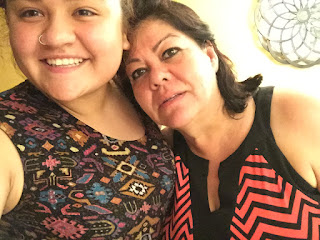
    (me and mentor/grandma/sara romo miranda)


    1. List the contact name, phone number, and organization of the person with whom you volunteered.
          
    Name: Sara Romo Miranda Phone Number: (626)419-8627 Organization: My World Speech Therapy 

    2. What qualified this person as an expert in your topic choice?     
    • What qualifies Mrs. Miranda as an expert in my topic choice is the fact that she went to college for 7 years and has a Masters Degree in science in the field of Speech and Language Pathology. She also owns a speech therapy business,  My World Speech Therapy, that she's run for 8 years. 
    • The most important thing I learned from this experience is that every speech therapist has their own way of being with the client and making sure the client is progressing. There is no "correct" way to help a client hit their mile stones. I also realized that while all these children have speech problems, their is still a wide range of struggle they could be going through.  No two children are alike as well as the treatment they are receiving. I think it's the most important because it shows me that if I did ever decide to pursue speech therapy, when I get to working with clients it is still possible to put my own twist into it. I can still make relationships with the children in my own way and I get to decide what I think will help them the most. I think the freedom to make your own choice is important when choosing a career. 
    • My senior project is going to be speech and language pathology. Mentorship didn't really help decide my senior project though. I chose this topic because my grandma and my mom are both speech therapist and my grandma owns her own speed therapy business so it's a very important part of my life that iv'e never really given to much attention. I decided that devoting a school year of my life to it would help show my appreciation for the craft as well as help me decide if I wanted to join the business eventually. What summer mentorship did help with was show me that speech therapy is not completely boring and that there are a lot of things to learn , so I would be okay dedicating my senior year to it. 



    3. List three questions for further exploration now that you've completed your summer hours.   

    Question 1: Is it much different, more complicated maybe,  working with a 3-4 year old compared to working with a 12-14 year old?
    Question 2: Do you think being a speech therapist makes it more stressful being a parent because there is a constant need to make sure your child is meeting the standard that you've been taught your child, at whatever age they are,  must be meeting?
    Question 3: Is it more comfortable working at a child's home, the main office, or at a school/hospital? 
    4. What is the most important thing you gained from this experience? Why?


    5. What is your senior project topic going to be?  How did mentorship help you make your decision?  Please explain.